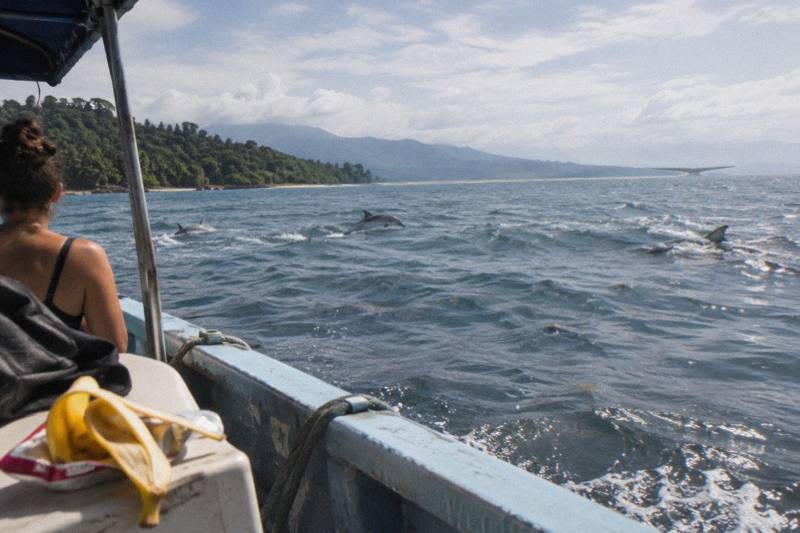
Whale Watching Uvita Vs Manuel Antonio Vs Drake Bay
Three bases, three very different whale trips. Here is how Uvita, Manuel Antonio and Drake Bay compare on season, boat rides, water and price.
Short answer
Uvita sits beside Marino Ballena National Park with whale tours from $75 per person and boats launching straight off the beach. Manuel Antonio is a bigger resort base further north, near Quepos. Drake Bay, further south on the Osa, is one of the access points for Caño Island. The humpback seasons are the same at all three, since the coast hosts both populations.
Costa Rica's Pacific coast hosts two separate humpback populations, one from each hemisphere, in different halves of the year. That is what the International Whaling Commission records for the country in its Costa Rica profile, and it is the reason the coast from Dominical through Uvita to Drake Bay supports a whale watching industry for most of the calendar. But the three main bases a traveler weighs, Uvita, Manuel Antonio and Drake Bay, are not interchangeable. They differ in how long the boat ride runs, how much a tour costs and how much travel each one demands before you ever step aboard.
This guide compares the three on the factors that actually decide the day. Uvita's own fleet is the reference point throughout, led by the drinks-and-snacks boat trip that tops the lineup with 4.5 from 775 reviews, from $95 per person. For the wider context on timing, the month-by-month breakdown in our guide to Best Time For Whale Watching In Uvita By Month covers the calendar in more detail.
Which Coast Has The Longest Whale Season?
None of them stands out, because all three bases share the same Pacific migration corridor and therefore the same seasons: southern-hemisphere humpbacks from roughly July to mid-November, peaking August to September for mothers and calves, and northern-hemisphere humpbacks from December to March or April, peaking January to February. What differs is not season length but how directly each base exploits that corridor.
Marino Ballena National Park was, per the national conservation system SINAC's official park page, the first protected area in Costa Rica created exclusively for marine resources, covering 5,160 marine hectares along a 15 km coastal strip. Uvita town sits beside that strip, and its boats launch from the beach there. SINAC names Bahia Drake, Bahia Uvita and Sierpe as the only access points for Caño Island, so Drake Bay and Uvita boats reach the same reserve.
The practical takeaway for a season planner: whales do not check which town your hotel is in. Southern humpbacks arrive from the Antarctic feeding grounds, the longest recorded humpback migration per the IWC handbook, and northern humpbacks arrive from off North America. For the full two-season story, our guide to Humpback Whales In Costa Rica: Two Migrations Explained unpacks the biology.
| Season window | Whales present | Operator-reported peak | Notes |
|---|---|---|---|
| July to mid-November | Southern-hemisphere humpbacks | August to September for mother-calf pairs | Longest migration, Antarctic feeders |
| December to March or April | Northern-hemisphere humpbacks | January to February | Dry season months per SINAC |
One operator claim worth handling carefully: the featured Uvita listing states on its own know-before-you-go text that December to March carries a 50 percent chance of sightings and July to October a 90 percent chance. That is one operator's statement on one listing, not a measured rate for the coast. Treat any sighting percentage anywhere on this coast as marketing language until you see its source.
Which Base Has The Shortest Boat Ride To The Whales?
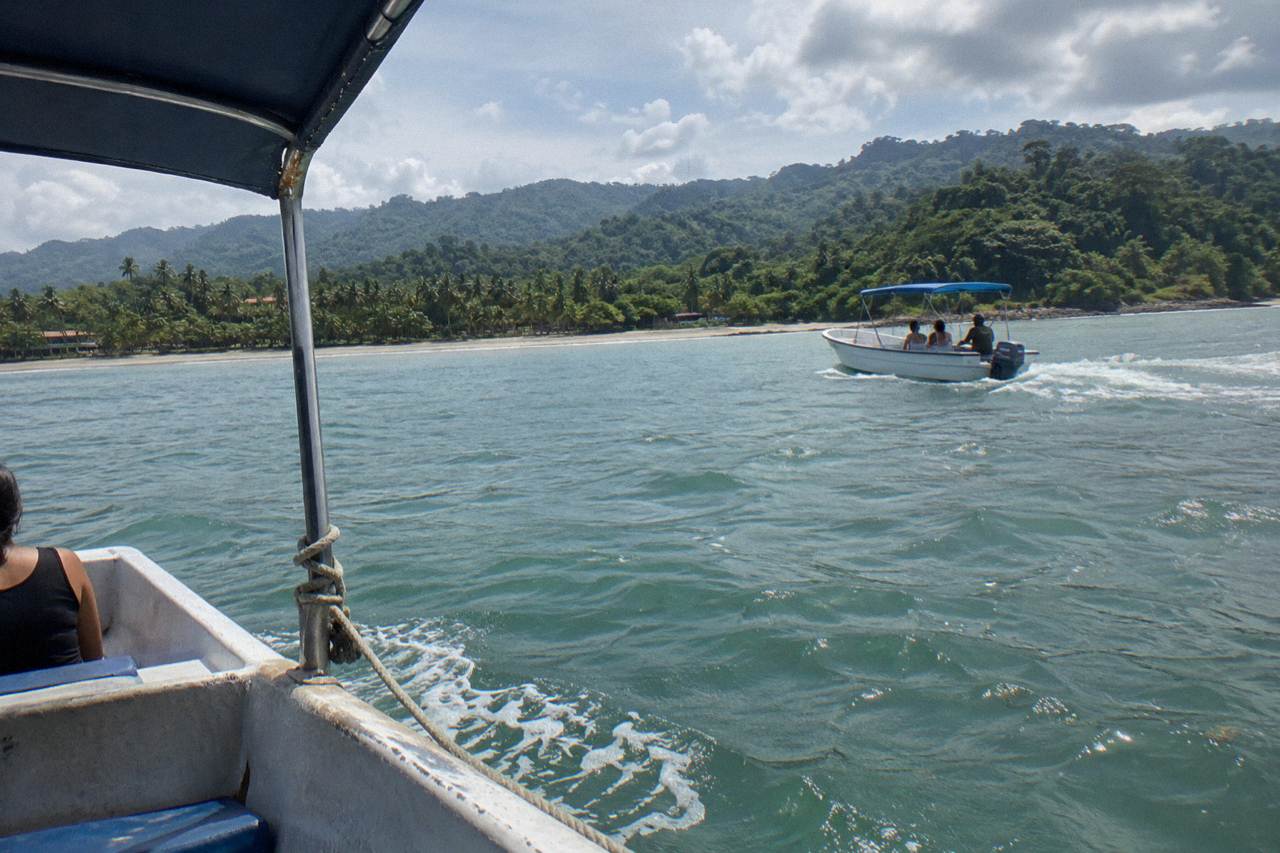
Uvita boats launch straight off the beach at Bahía Ballena, inside Marino Ballena National Park, with no dock and usually a quick wade to the boat, so the whale water starts at the shoreline. Caño Island days are the long rides: about 50 to 80 minutes each way from Uvita, according to one operator source.
The beach launch is worth knowing before you book anywhere in Uvita. One listing states plainly that there is no dock and boarding happens directly from the sand, which means shorts, sandals you do not mind wetting, and a degree of mobility that a marina step-on boarding does not demand.
From Manuel Antonio the arithmetic changes. The road from Quepos to Uvita is listed at roughly 40 to 62 km depending on the source, about 30 to 49 minutes on Highway 34, so a traveler based in Manuel Antonio who wants the Marino Ballena experience can take that drive on the morning of the trip.
If you are weighing the bases from the capital first, our guide to San Jose To Uvita: Getting There For A Whale Trip covers the roughly 222 km drive, bus options and flight alternatives in full.
Is Whale Watching From Manuel Antonio Any Good?
Manuel Antonio sits on the same Pacific coast the humpbacks use. If whales are your main goal, Uvita and the Marino Ballena park waters, 30 to 49 minutes south by road, are the stronger choice.
The honest framing is this: if your trip is built around Manuel Antonio's beaches and park and you want whales as one activity among several, a Quepos whale trip is a reasonable add-on. If whales are the point of the trip, basing in Uvita puts you beside Marino Ballena National Park, with listings that state park entry is included in the ticket, as most of the lineup does.
There is also a cost angle. Uvita's whale listings start at $75 per person for the morning Bahía Ballena tour, 4.8 from 210 reviews, and the most reviewed boat listed here runs from $95 with drinks, snacks and the park fee rolled in. Our guide to How Much Does Whale Watching Cost In Uvita shows what the lineup charges line by line.
A reader deciding between the two towns on more than whales should read our answer to Is It Better To Stay In Manuel Antonio Or Uvita?, which covers lodging, food and atmosphere rather than just the boat logistics covered here.
Is Drake Bay Worth The Extra Travel For Whales?
Drake Bay is only worth the extra travel for whales if you are already committed to the Osa region and prize remoteness over convenience. Drake Bay is one of the three access points SINAC names for Caño Island Biological Reserve. If whales are your priority, Uvita offers the same migration with far less travel.
Drake Bay's strength is the reserve. Caño Island, per SINAC's reserve page, is reached only by sea, requires prior reservation, charges foreign adults USD 16.95 entry and permits no landing: boats work the marine side only. That makes a Drake Bay or Uvita Caño trip a full 6 to 8 hour day built around snorkeling and the marine life one listing names: sharks, manta rays, turtles and fish.
Travel time is the real cost. Uvita is about 222 km from San Jose by Route 34, roughly 3.5 hours by one route estimate, while Drake Bay lies further south on the Osa Peninsula, past Uvita, so every Drake Bay journey adds travel on top of the Uvita drive. If your itinerary already includes the Osa, our guide to Osa Peninsula Travel Guide From The Uvita Side is the right planning page. If it does not, adding a peninsula crossing for a whale trip you could take from Uvita is hard to defend on time alone.
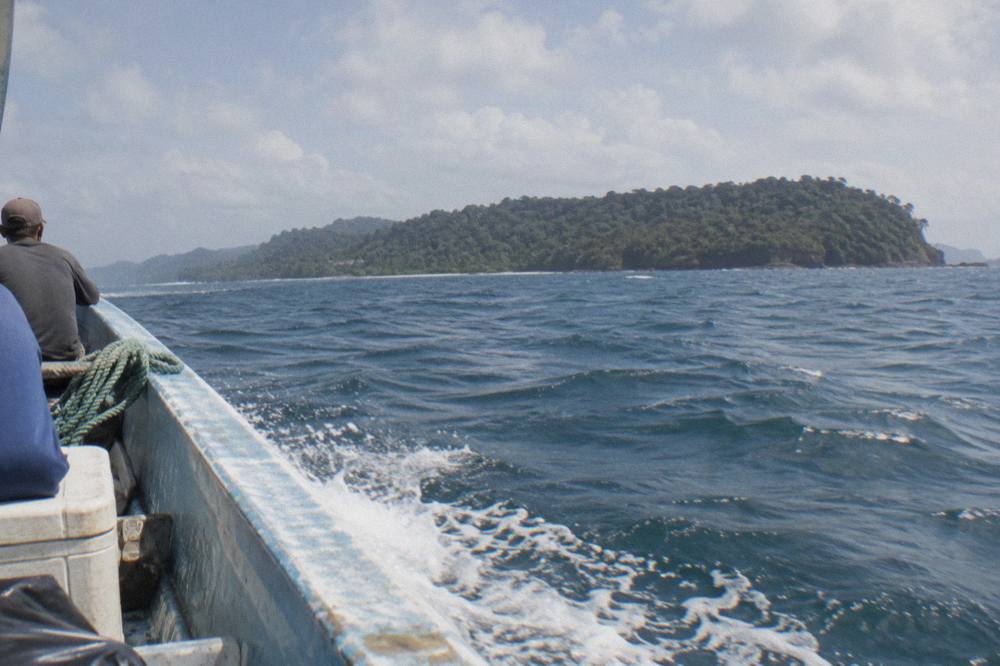
One more Osa nuance: both Uvita and Drake Bay boats work the same reserve waters. Uvita's own Caño listings, like the full-day snorkel at 4.7 from 135 reviews from $160 with check-in pastries and a picnic lunch included, mean a traveler based in Uvita does not surrender the Caño experience by skipping Drake Bay. The Caño Island from Uvita guide covers that day trip in depth.
What Does Each Base Cost For A Whale Trip?
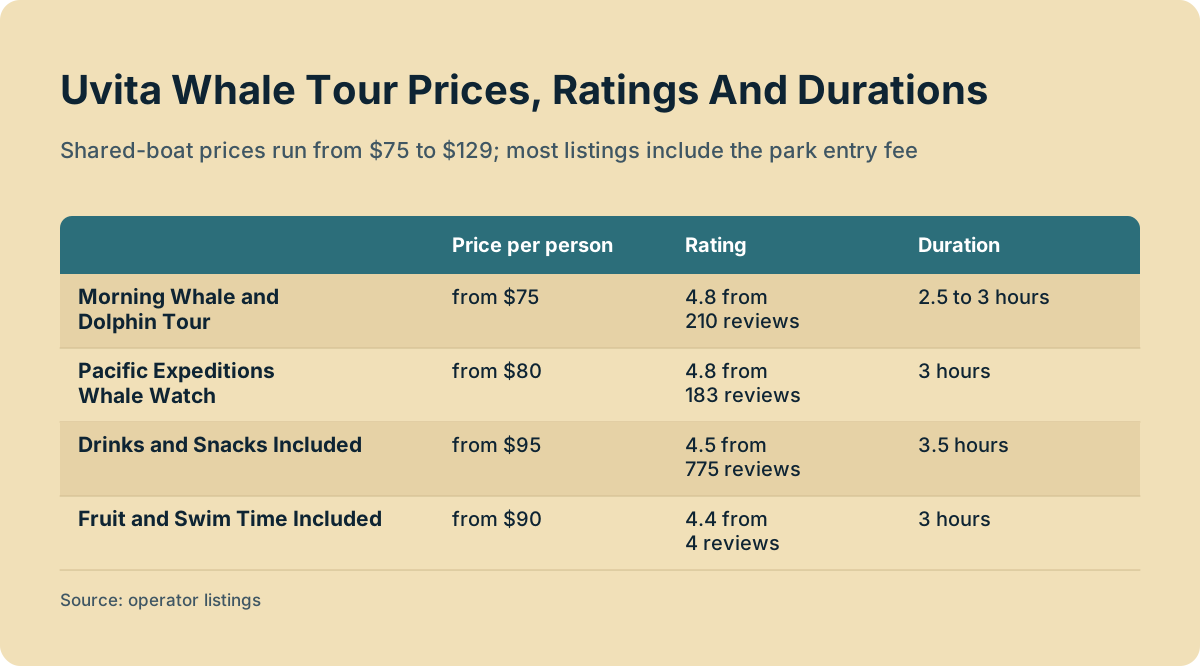
Uvita's published whale tour prices run from $75 to $129 per person across the shared boats, plus a private cruise at from $1,120 per group, and most listings include the Marino Ballena park entry fee in the ticket. Where you base yourself also shapes the overall cost of a whale watching trip, so our answer to Is It Better To Stay In Manuel Antonio Or Uvita? is a useful next read.
The lowest-priced listing is the morning Bahía Ballena whale and dolphin tour at from $75 per person, 4.8 from 210 reviews, with snacks, water and snorkel equipment listed. The premium end locally is the humpback research trip at from $129 per person, which includes a biologist expedition leader and a donation to a humpback research project, and, at 10 reviews, has too small a pool for a star rating to mean much. Note the honest reading of review counts: a 4.8 from 210 reviews and a 4.5 from 775 are solid signals; a 5.0 from a handful of reviews is not.
| Uvita listing | Price per person | Rating | Duration |
|---|---|---|---|
| Morning Whale and Dolphin Tour | from $75 | ★ 4.8 · 210 reviews | 2.5 to 3 hours |
| Pacific Expeditions Whale Watch | from $80 | ★ 4.8 · 183 reviews | 3 hours |
| Drinks and Snacks Included | from $95 | ★ 4.5 · 775 reviews | 3.5 hours |
| Fruit and Swim Time Included | from $90 | ★ 4.4 · 4 reviews | 3 hours |
| Humpback and Wildlife Focus | from $129 | ★ 4.2 · 10 reviews | 3 hours |
| Private Cruise, Meal Included | from $1,120 per group | no reviews yet | 3.5 hours |
Park fees matter to the math only when a tour does not include them. SINAC sets non-resident adult entry to Marino Ballena at USD 6.78, card payment only, valid for the day; most Uvita tour tickets fold this in, and the private charter listing at from $95 per person with a group-size price note carries its own caveat to confirm on the booking page. Our guide to Marino Ballena National Park Entrance Fee And Tours explains when you pay separately.
For the in-between option, the whale and snorkel combo pairs the watching with a reef stop at from $84.42 per person, 4.3 from 136 reviews, which our guide to Whale Watching And Snorkeling Combo From Uvita compares against the pure whale boats.
Which Coast Has The Calmer Water For A Boat Day?
The dry season, mid-December to mid-April per SINAC, brings the least rain to boat days on this coast, with February and March the lowest-rainfall months on long-term averages. Sea state changes day to day at every base, no operator can promise it, and trips may be rerouted or cancelled.
Bahía Ballena's Whale Tail tombolo is reachable on foot only at low tide, per SINAC, with coral reef on its left side and around Isla Ballena. Caño crossings are the long open-water runs: the Uvita to Caño run alone is quoted at 50 to 80 minutes each way, and sea state decides whether the snorkel stops happen. Travelers prone to seasickness should weight this factor more heavily than price.
Conduct rules do not differ by town. Under the national cetacean regulations, boats keep at least 100 m from whales and 50 m from dolphins with the engine on, spend at most 30 minutes with any group, and allow at most two boats around the same animals. Our guide to Whale Watching Boat Rules And Ethics In Costa Rica covers the full framework, which applies to licensed operators wherever they depart from.
How Do The Three Bases Compare Side By Side?
Uvita sits beside Marino Ballena National Park with published prices from $75 per person; Manuel Antonio is a bigger resort base 30 to 49 minutes north by road; Drake Bay is a remote Osa base and one of the access points for Caño Island. On season length the three tie, because the whales are the same animals on the same corridor. The decision is really about what kind of trip you want around the two or three hours you spend on the water.
The table below compresses the comparison into the factors this guide has covered.
| Factor | Uvita | Manuel Antonio | Drake Bay |
|---|---|---|---|
| Whale season | Both humpback populations, July to mid-Nov and Dec to March/April | Same corridor, same windows | Same corridor, same windows |
| Typical whale tour | 2.5 to 4 hours shared boat | Not covered on this site | Caño Island days |
| Published local prices | $75 to $129 per person shared, from $1,120 private group | Not covered on this site | Not covered on this site |
| Getting there from San Jose | About 222 km, about 3.5 hours by Route 34 | Shorter drive, then 30 to 49 minutes on to Uvita | Further than Uvita, beyond it on the Osa |
| Best for | Whale-first trips, short rides, published pricing | Resort travelers adding whales | Remote-nature travelers already in Osa |
If you're leaning toward Uvita for its beach launches and quick boat access, our guide to Car Rental In Uvita Costa Rica: Do You Need One covers parking near the departure beach and which trips run smoother with your own wheels.
Which Base Should You Choose For Your Whale Trip?
Pick Uvita when whales are the whole point of the trip: boats launch beside the park and published prices start at $75 per person. Pick Manuel Antonio if you want a resort town and accept a 30 to 49 minute drive to the park waters. Pick Drake Bay just when remoteness and the Osa region already draw you, with whales as a bonus.
A concrete Uvita plan is easy to assemble. The morning tour at from $75 suits budget and early risers. The most reviewed boat, the drinks-and-snacks trip at from $95, 4.5 from 775 reviews, up to 80 guests, with park entry, fruit, juice and coffee included and free cancellation listed, suits most first-time visitors, and you can check availability on its listing alongside the drinks and snacks whale boat tour page. The research-led trip at from $129 suits travelers who want a biologist aboard, with the caveat that its review pool of 10 is small. Families should read our guide to Whale Watching With Kids In Uvita: Ages, Safety And Timing before booking any base.
Timing still outranks base. A September week in Uvita during the southern mother-calf peak beats a May week in any of the three towns, because May sits in the gap between the two migrations. Pick the month first with our guide to Best Time For Whale Watching In Uvita By Month, then pick the base that fits the rest of your trip around it.
For travelers who land in Uvita and want both boat experiences without choosing a far base, the Caño Island versus Marino Ballena comparison settles which day trip deserves your time, and Uvita Whale Watching lists every trip listed here.
Common Questions About Whale Watching Bases
Is Whale Watching Better From Uvita Or Manuel Antonio?
For a whale-focused trip, Uvita: boats launch inside Marino Ballena National Park, rides run 2.5 to 4 hours, and prices start at $75 per person. Manuel Antonio suits travelers whose trip centers on its park and beaches, with whales as one activity.
Can You See Whales From Manuel Antonio?
Manuel Antonio sits on the same Pacific coast the humpbacks use, with southern humpbacks roughly July to mid-November and northern humpbacks December to March or April. No base guarantees sightings, and Uvita's park waters are 30 to 49 minutes south by road.
How Far Is Manuel Antonio From Uvita?
Roughly 40 to 62 km depending on the route source, about 30 to 49 minutes on Highway 34. That is close enough to base in one town and take a whale tour from the other.
Is Drake Bay Good For Whale Watching?
Drake Bay is one of the three access points SINAC names for Caño Island Biological Reserve, where landing is not permitted and only the marine part is open for snorkeling and diving. It is best for travelers already committed to the Osa region.
What Is The Cheapest Whale Tour From Uvita?
The morning Bahía Ballena whale and dolphin tour at from $75 per person, 4.8 from 210 reviews, is the lowest listed price. Most Uvita tours also include the Marino Ballena park entry fee, which SINAC prices at USD 6.78 for non-resident adults if paid separately.
Which Month Is Best For Whales On This Coast?
August and September for the southern-hemisphere humpbacks, especially mother-and-calf pairs, and January and February for the northern-hemisphere whales, per operator pages on both windows. February and March carry the lowest long-term rainfall averages, which helps boat-day odds.