Humpback Whales In Costa Rica: Two Migrations Explained
Costa Rica's Pacific coast hosts two distinct humpback populations, one from each hemisphere, and their back-to-back calendars are the reason Uvita boats find whales in most months of the year.
Short answer
Two humpback populations visit Costa Rica: southern-hemisphere whales from July to mid-November, peaking August to September with mother-calf pairs, and northern-hemisphere whales from December to March or April, peaking January to February. Marino Ballena National Park off Uvita sits on the coast both populations visit.
Most coastlines get one humpback season. Costa Rica gets two, from populations that never meet in their feeding grounds. The southern animals breed here in the middle of the year, which is their winter; the northern animals arrive from December, which is theirs. The International Whaling Commission's Costa Rica profile describes the southern migration as the longest recorded migration, animals that feed around the Antarctic Peninsula and southern Chile and then travel to these waters to breed.
The practical consequence for anyone planning a trip is simple: Uvita, the departure town for Marino Ballena National Park, has boat trips finding whales in far more months than a single migration would allow. This guide explains both calendars, what the whales are actually doing in Bahía Ballena, how whale watching works under Costa Rican law, and which trips listed on Uvita Whale Watching fit each window. For a month-by-month breakdown, see our guide to Best Time For Whale Watching In Uvita By Month.
Why Do Humpback Whales Visit Costa Rica Twice A Year?
Costa Rica's Pacific waters host breeding humpbacks from both hemispheres, which is why whale season here runs close to eight months. The two populations are separate groups with separate feeding grounds, one in Antarctic and southern Chilean waters, one off the northwest coast of the United States, and each arrives when its own hemisphere's winter drives it to warm water.
Humpbacks come to warm tropical water to mate, give birth and nurse, per the IWC. The bays and reef-protected shallows of the Costa Rican south Pacific fit that need, and Marino Ballena National Park, the first protected area in Costa Rica created exclusively for marine resources, spans 5,160 marine hectares of exactly this kind of habitat along a 15 km coastal strip.
The southern-hemisphere whales make the longer journey. They feed in Antarctic waters, then swim north to Central America in the middle of the year. The northern-hemisphere whales feed off California, Alaska and British Columbia, then swim south in what is their winter, December through spring. Two populations, two calendars, one coastline.
The two seasons follow each other: when the southern animals leave in November, the northern animals arrive in December. This is why operator pages describe the area as having near year-round whale presence, and why the same boat route out of Uvita produces whales in both September and February, just from animals that share no feeding ground. If you're trying to pick which of the two seasons suits your trip better, our answer to What Is The Best Time Of Year To See Whales In Costa Rica? weighs sea conditions against what each migration actually offers.
When Are Humpback Whales In Costa Rica?
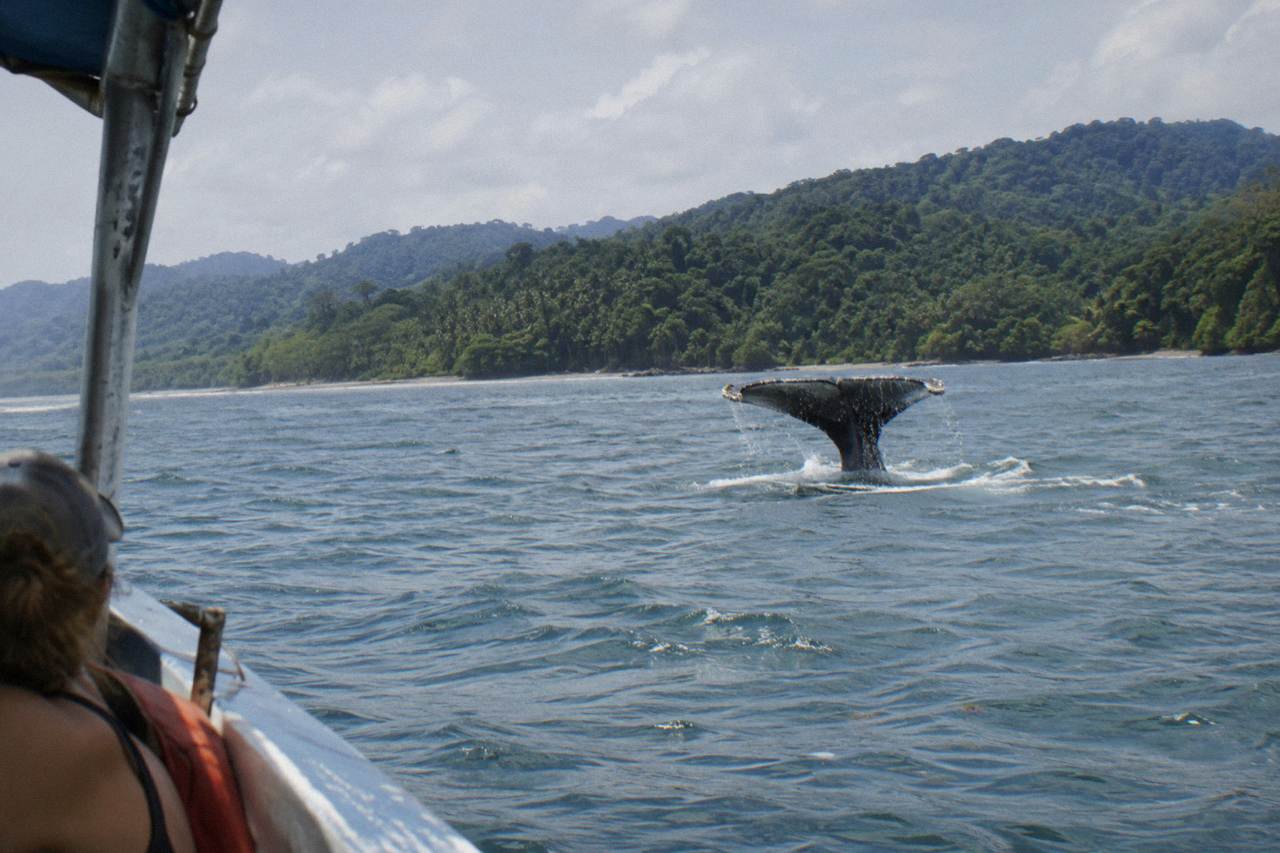
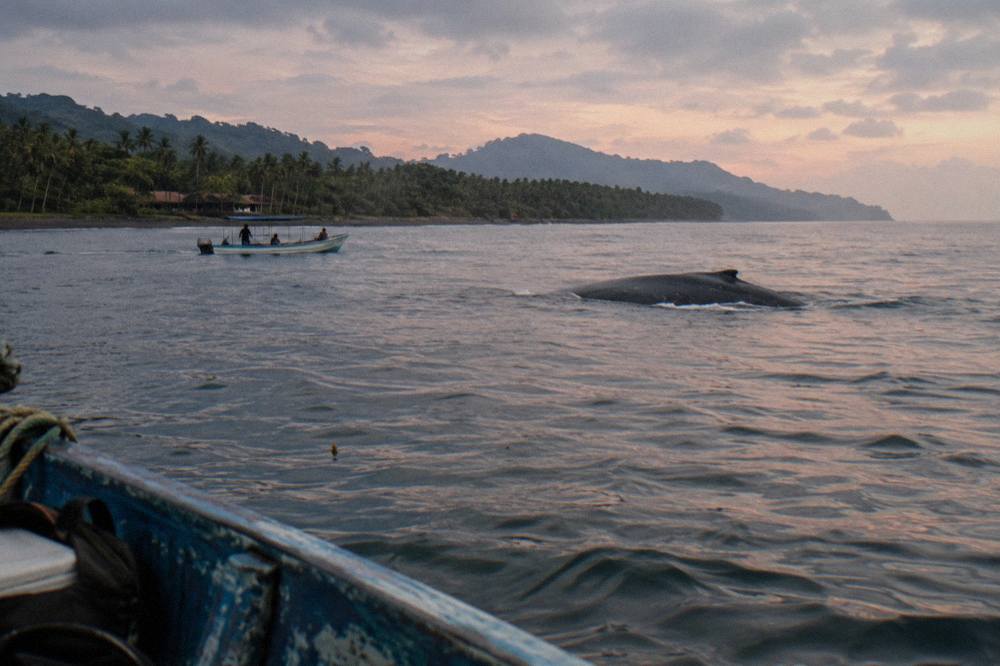
Southern-hemisphere humpbacks are present from July to mid-November, with operator pages pointing to August and September as the peak for mother-calf pairs. Northern-hemisphere humpbacks are present from December to March or April, peaking January to February. Between those windows the animals have left, but resident dolphins remain year-round.
The July to mid-November window comes straight from the IWC handbook's country profile, which describes humpbacks that feed around the Antarctic Peninsula and southern Chile breeding in Costa Rica during those months. Operator and lodge pages for the Marino Ballena area narrow the peak to August and September, when mother-calf pairs are most commonly reported. That timing is also why the community of Bahía Ballena holds its whale and dolphin festival each early September, with the 16th edition running 4 to 6 September 2026 with special tour prices for nationals, concerts and a running race, per local reports. All those boats sharing the water with mother-calf pairs raise a fair question, and our answer to Are Humpback Whales Friendly To Humans? sorts what the rules and guest reports from Uvita actually say from the myths.
The December to March or April window carries the northern animals, with operator pages naming January and February as the peak months. One operator's own listing for the most reviewed boat trip on this site, the drinks-and-snacks trip carrying up to 80 guests from $95 per person, states in its know-before-you-go notes a 50 percent sighting chance from December to March and 90 percent from July to October. That is one operator's statement about its own trips, not a rate for the coast; official sources publish no sighting rate for Marino Ballena.
| Window | Population | Feeding grounds | Peak months | What the sources describe |
|---|---|---|---|---|
| July to mid-November | Southern hemisphere | Antarctic Peninsula, southern Chile | August to September | Mother-calf pairs, breeding activity |
| December to March or April | Northern hemisphere | California, Alaska, British Columbia | January to February | Mating, calving and nursing (IWC) |
Between mid-April and the end of June the humpback calendar is quiet, though the IWC handbook names common bottlenose and pan-tropical spotted dolphins as species commonly viewed on tours, and local wildlife sources describe them as year-round residents. A June boat trip is a dolphin trip in practice; a September one is the strongest humpback month this coast offers, with the honest caveat that no boat can promise a sighting.
SINAC defines the dry season as mid-December to mid-April and the rainy season as mid-April to mid-December, and February and March are the lowest-rainfall months on long-term averages. September sits deep in the rainy season, yet it is the southern season's peak; rain on land and whales offshore are separate variables.
If the migration windows are what set your dates, these are the three listings this site would weigh first.
The first is a biologist-led trip built around the whales themselves, the second is the most reviewed option listed here, and the third is an expert-guide outing. All three run about three hours and depart from Uvita.
What Do Mother And Calf Pairs Do In Bahía Ballena?
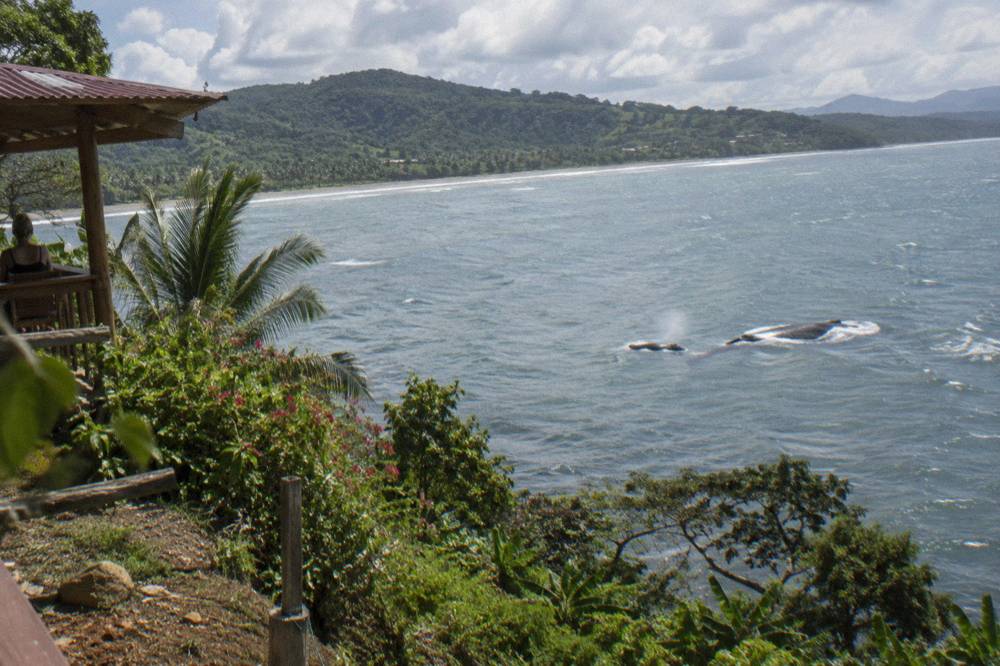
Females come to these warm, protected waters to give birth and nurse, using the warm bay as a nursery. Mother and calf pairs are most commonly reported in August and September, and one guest review describes at least 20 minutes alongside one pair.
If you're curious about the longer journey that brings pregnant females to this coast, our answer to Where Do Whales Give Birth? explains the timing, the reasons, and how to spot mothers with calves from Uvita.
One guest review of the 3 to 4 hour whale and dolphin watching listing, which runs up to 20 guests from $92 per person and includes a coffee station before departure, puts it plainly: "We observed a mother and baby humpback whale for at least 20 minutes. In addition we saw some sea turtles and had the chance to swim in the sea. It was overall a great trip!" Another, from the Marino Ballena Tours listing with 110 reviews, describes "a mother whale and her calf, and at another spot, we also saw a bull with some dolphins."
Because calving is the whole point of the migration, the law protects it specifically. The rules below govern every licensed boat in the park, and we cover them in full in our guide to Whale Watching Boat Rules And Ethics In Costa Rica. The short version for a reader choosing a date: the mother-calf peak is August to September, and that is also when responsible-boat behavior matters most.
Planning a trip around the calf season? The biologist-led trip is the natural fit.
It is priced from $129 per person, includes a donation to a humpback whale research project, and lists a biologist expedition leader, water, fruit and an informative talk about whale watching among its inclusions. The listing carries free cancellation, so a September date can be locked early.
How Close Do Boats Get To Humpbacks In Marino Ballena?
Under Decreto Ejecutivo 32495, boats must stay at least 100 metres from whales and other cetaceans longer than 5 metres, at least 50 metres from dolphins with the engine running, and no more than two boats may observe the same group, for a maximum of 30 minutes. Swimming with, touching or feeding cetaceans is prohibited outright.
The decree, signed in 2005, is the operating rulebook for whale watching trips in Costa Rican waters. Approach must be diagonal from the rear, parallel to the animals' course. Speed inside observation areas is capped at 4 knots, always slower than the slowest animal present. Once the engine is switched off, it is not restarted until the cetacean is at least 50 metres away and at the surface.
| Rule | What Decreto 32495 says |
|---|---|
| Whales over 5 m | No closer than 100 metres |
| Dolphins, engine on | No closer than 50 metres |
| Dolphins, engine off | No closer than 30 metres |
| Boats per group | At most two, others wait 200 metres back |
| Time with a group | 30 minutes maximum |
| Mother with calf | Stricter still; never come between mother and calf |
| Swimming, feeding, touching | Prohibited |
Two practical notes for guests. First, the 100 metre distance is the law, and breaching happens wherever the whale decides. Second, boats coordinate with each other. A guest review of the 3-hour whale combo describes exactly this: "they had excellent communication with other boats so once one whale was spotted we were able to get there quickly and be very close to them."
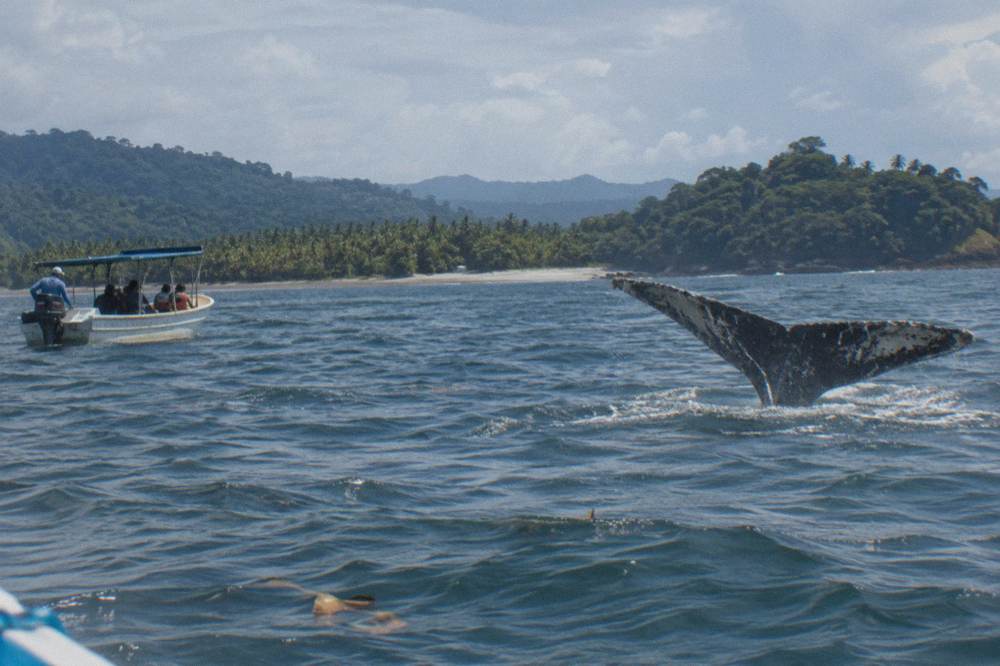
What Does A Humpback Watching Trip From Uvita Actually Show?
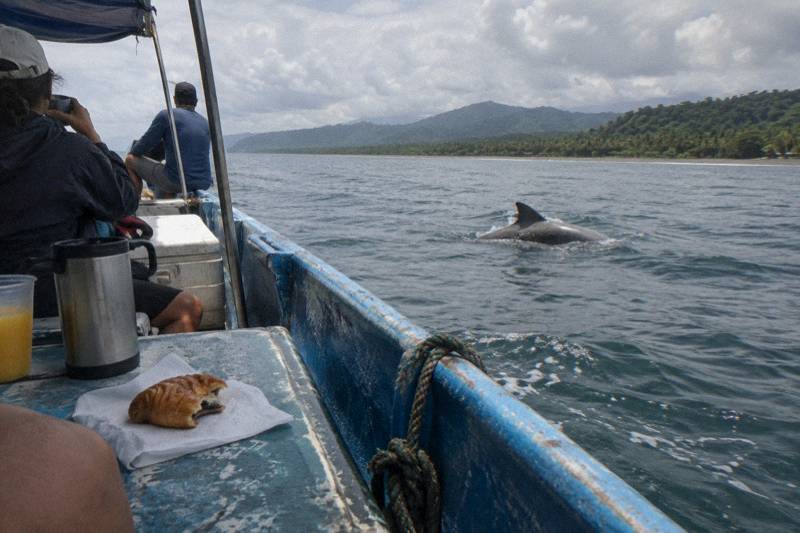
A standard trip is a roughly three-hour shared boat run from Uvita or Bahía Ballena beach into the park's marine area, with a guide, safety gear, fruit and water on most listings, and park entry on 14 of the 18 shared whale and combo listings. Several boats launch directly from the beach with no dock, so guests should expect to wade briefly to board.
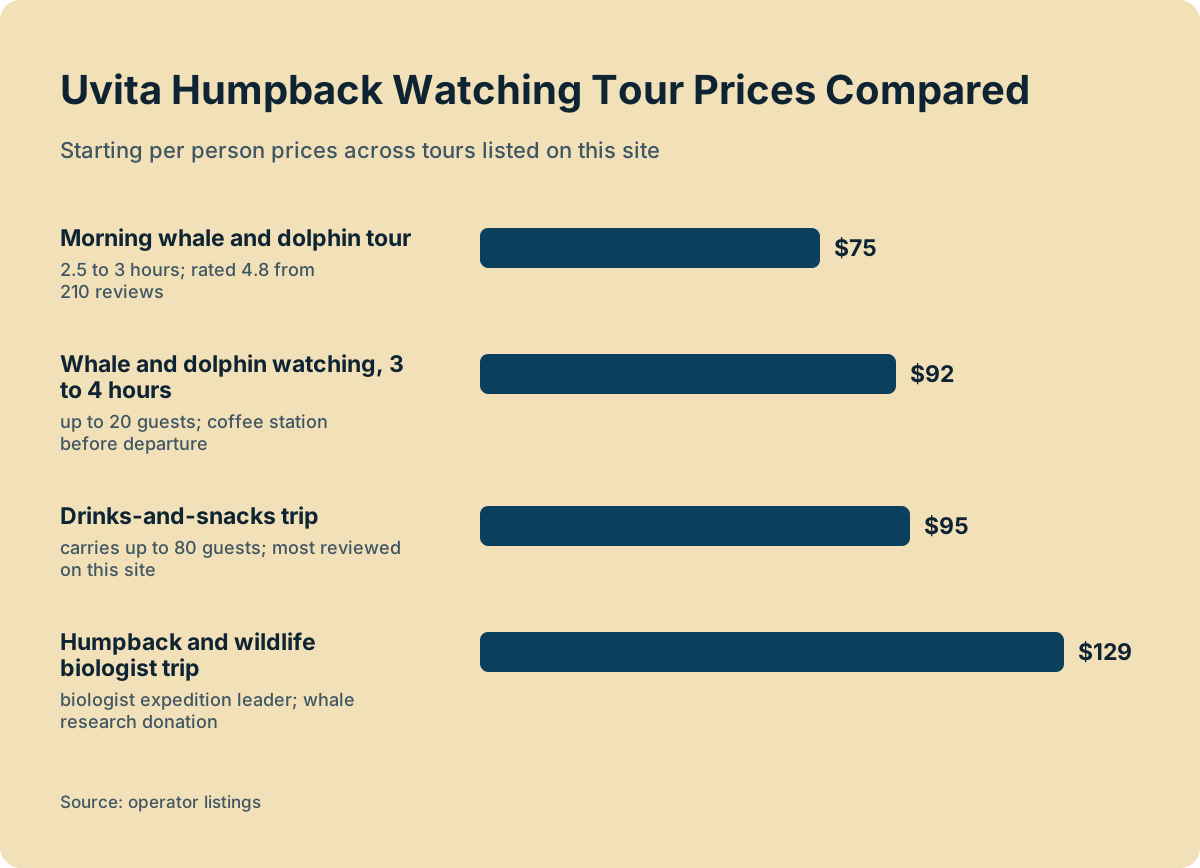
The shape of the product is consistent across the listed tours: launch, work the whale and dolphin grounds, and often add a swim stop when conditions allow. The differences between listings are price, group size and inclusions, which we compare in detail in our guide to Whale Watching Tours From Uvita Compared: Group, Private And Combo. The featured listing on this site, the drinks and snacks trip, carries a 4.5 rating from 775 reviews, runs 3.5 hours for from $95 per person, includes juice, coffee, pastries, bananas, tropical fruit, the Marino Ballena entry fee and parking, and explicitly excludes hotel pickup, alcoholic drinks and snorkel gear.
The morning whale and dolphin tour, at 4.8 from 210 reviews and from $75 per person, is the lowest-priced listing here, 2.5 to 3 hours with snacks, bottled water, snorkelling equipment and free on-site parking listed. One guest on that trip describes the choice many boats offer mid-tour: "We were given the choice of finding more whales or snorkeling at the Whale’s Tail. The boat voted for snorkeling."
It is worth saying plainly that no listing promises a sighting. Sea state and the animals decide, boats cancel or reroute for weather, and the honest framing is that peak months raise the odds without ever making them a certainty. Dolphins, resident year-round, are the reliable second act; the IWC handbook names bottlenose and pan-tropical spotted dolphins as species commonly viewed on Costa Rican tours.
A few grounded details make the day smoother. Marino Ballena entry, per SINAC, costs USD 6.78 for non-resident adults and USD 5.65 for non-resident children, card payment only, valid for the day, though most listings include the marine entry in the tour price. Several boats have no restroom on board, an exclusion stated on some listings, so check the listing if that matters. Minimum ages vary by listing, so check the listing rather than assume.
For the full picture of trip formats and pricing tiers, our guide to How Much Does Whale Watching Cost In Uvita breaks down the range from $75 to the private cruise at $1,120 per group.
Which Uvita Boat Trips Fit Each Humpback Season?
For the August to September calf peak, the biologist-led humpback and wildlife trip from $129 per person is built for it. For the January to February northern season, the most reviewed drinks-and-snacks trip at from $95 or the expert-guide trip at from $96 both work; all three are 3 to 3.5 hour shared boats from Uvita with free cancellation listed.
The match is less about the boat and more about what you want beside the whales. The humpback-focused trip includes an informative talk, a research donation and a biologist as expedition leader, plus snorkelling when weather allows. The 775-review trip is the volume choice, up to 80 guests, pastries and bananas, juice and coffee. The expert-guides adventure, 4.7 from 26 reviews, from $96, keeps things simple: park ticket, hydration, fruit, bilingual guide, three hours on the water.
Outside the two humpback windows, the calculus changes. A June or May trip is really about dolphins and the coastline, and the combo listings, which pair whale watching with a snorkel stop in three hours from $84.42 per person, suit that brief well. We treat those separately in our guide to Whale Watching And Snorkeling Combo From Uvita.
| Listing | Rating and reviews | Price from | Length | Best seasonal fit |
|---|---|---|---|---|
| Humpback and Wildlife Focus | ★ 4.2 · 10 reviews | $129 per person | 3 hours | August to September calf peak |
| Drinks and Snacks Included | ★ 4.5 · 775 reviews | $95 per person | 3.5 hours | Either season; most reviewed option |
| Expert Guides Whale Watch | ★ 4.7 · 26 reviews | $96 per person | 3 hours | January to February northern season |
| Morning Whale and Dolphin Tour | ★ 4.8 · 210 reviews | $75 per person | 2.5 to 3 hours | Any month; lowest price |
| Whale and Dolphin Watching, 3 to 4 hours | ★ 4.6 · 107 reviews | $92 per person | 3 to 4 hours | Southern season; includes Whale's Rock or Ventanas Cave visit |
Families should read our guide to Whale Watching With Kids In Uvita: Ages, Safety And Timing before booking, since minimum ages are a check-the-listing matter across the listed tours. And if you are weighing whether the whole outing justifies its price, our answer to Is Whale Watching In Costa Rica Worth It? works through the honest arithmetic.
Do Other Whales And Dolphins Show Up In Marino Ballena?
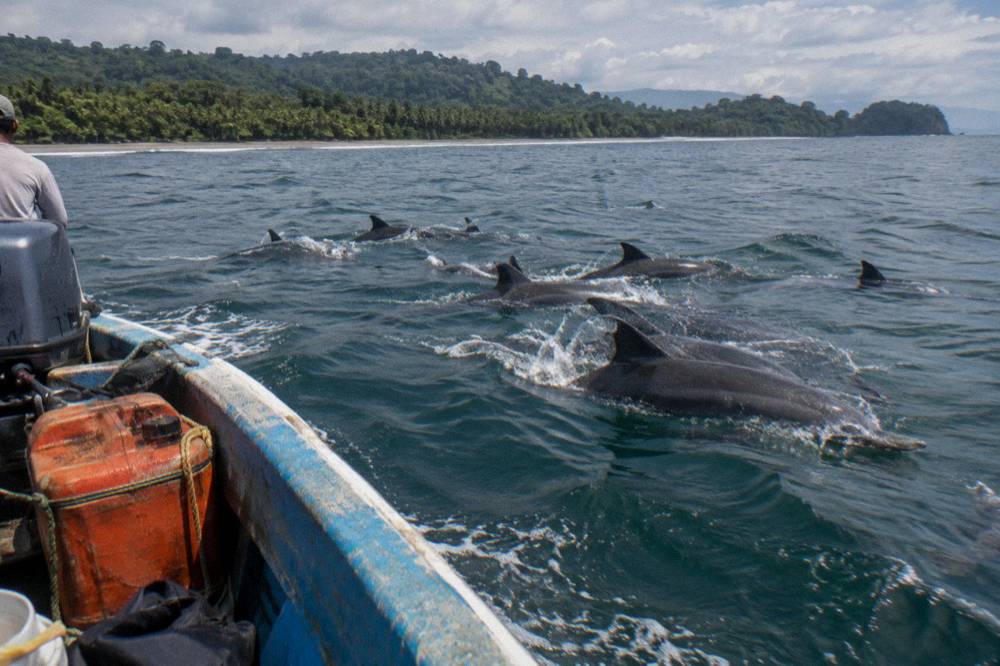
Yes. Beyond the two humpback populations, tours in Marino Ballena commonly report bottlenose and spotted dolphins year-round, spinner dolphins, sea turtles and manta rays, per operator and wildlife sources and SINAC's own species list for the park.
SINAC's park page names humpback whale, spotted dolphin, bottlenose dolphin, manta ray, hammerhead shark and parrotfish among the park's fauna. The IWC handbook reports that as many as 34 species of whales and dolphins have been recorded in Costa Rican waters overall, and names bottlenose and pan-tropical spotted dolphins as commonly viewed on tours. Olive ridley and hawksbill turtles nest on this coast too, per local wildlife sources.
The reviews on this site's listings back that up. One guest on the 3 to 4 hour listing mentions sea turtles alongside the mother-calf pair. Another, on the morning tour, describes dolphins and whales in the same trip. The dolphins are the constant; the whales are the season.
For readers whose interest in the animals runs deeper than the boat ride, our answer to Where Do Whales Give Birth? expands the nursery story, and SINAC's official Marino Ballena National Park page carries the current sector hours, fees and tide warnings for the whale tail sandbar.
The festival weekend deserves a note for September travelers. Local reports describe tours at special prices for nationals, concerts, free surf classes, an artisan fair and a recycled-material whale sculpture, organized with national tourism board support. It is a yearly early-September event.
Common Questions About Humpback Whales In Costa Rica
Why Do Humpback Whales Visit Costa Rica Twice A Year?
Because two separate populations, one from each hemisphere, breed in the same warm Pacific waters on opposite calendars. Southern-hemisphere whales arrive July to mid-November; northern-hemisphere whales arrive December to March or April. The back-to-back timing of their seasons, not any single population's stay, is what gives the coast close to eight months of whale presence.
When Are Humpback Whales In Costa Rica?
Southern-hemisphere humpbacks are present July to mid-November, peaking August to September for mother-calf pairs. Northern-hemisphere humpbacks are present December to March or April, peaking January to February. The quiet months for humpbacks are roughly mid-April through June, though resident dolphins remain year-round.
Can You See Baby Whales In Marino Ballena?
Mother and calf pairs are most commonly reported in the southern season, especially August and September, and one guest review describes staying alongside a pair for at least 20 minutes. No operator can promise a sighting, but the calf season is the window those sightings concentrate in.
How Close Do Boats Get To Humpbacks In Marino Ballena?
Costa Rican law requires boats to stay at least 100 metres from whales and other large cetaceans, at least 50 metres from dolphins with the engine on, and allows at most two boats with any group for up to 30 minutes. Swimming with, touching or feeding the animals is prohibited.
Are Humpback Whales In Costa Rica Dangerous To Swimmers?
Costa Rican law prohibits swimming near cetaceans. Swim stops, where a listing offers them, happen away from the animals and depend on conditions on the day. Check sea conditions with the operator before any swim.
Which Uvita Tour Is Best For The September Calf Season?
The humpback and wildlife focused trip, from $129 per person, is built around exactly this window, with a biologist expedition leader, a research donation and an informative talk included. The most reviewed listing here, 4.5 from 775 reviews at from $95 per person, covers the same waters with drinks and snacks included.