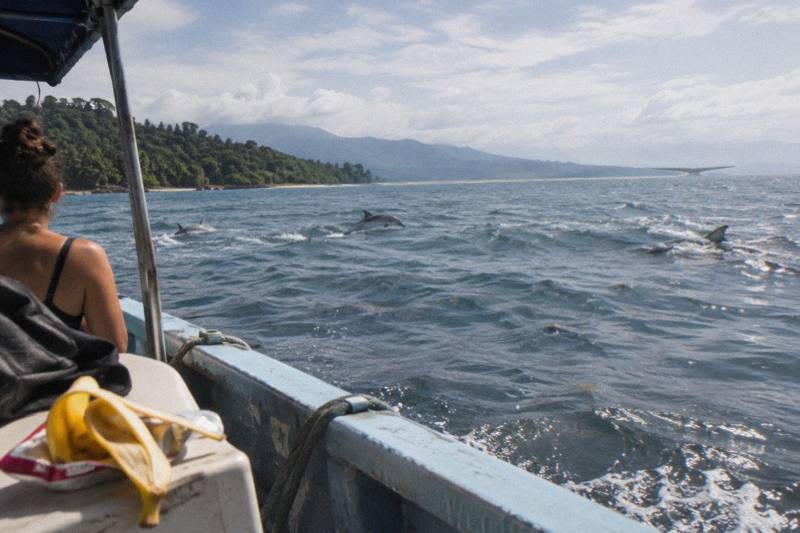
Dolphin Watching From Uvita: Spotted And Bottlenose Pods
Uvita's whale boats share the water with dolphins in every month. Here is what actually swims in Bahía Ballena, when, and how the tours work.
Short answer
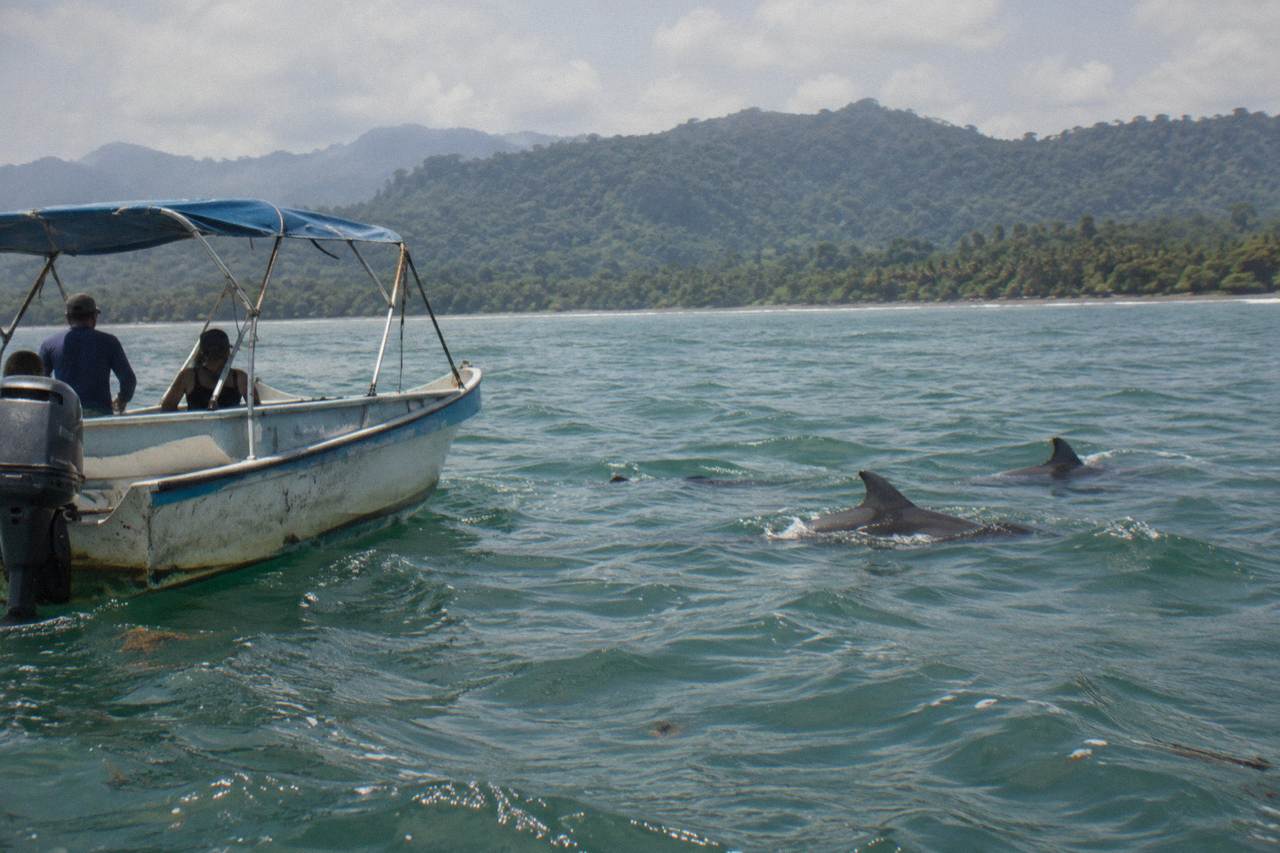
Bottlenose and pan-tropical spotted dolphins live around Bahía Ballena year-round, and spinner dolphins also appear in local wildlife accounts. There is no dedicated dolphin-only boat listed here: dolphins are part of the whale trips, from $75 per person, with 3 hours the standard length.
Humpbacks get the posters, but the dolphins do the daily work. Bahía Ballena, the bay that gives Marino Ballena National Park its whale-shaped name, holds resident dolphin populations: they are there in the dry season, there in the rains, and there on the flat gray mornings when no whale is breaching for miles. That is why every shared whale boat out of Uvita is, in practice, a whale and dolphin trip, and why the site's most reviewed listing, a 3.5-hour boat trip with drinks and snacks from $95 per person, puts both animals in its name. This guide covers which dolphins you can realistically meet, how the seasons change the mix, what the law says about how close boats may go, and which listings fit which kind of traveler. If the dolphins leave you curious about the bay's bigger residents, our answer to Are Humpback Whales Friendly To Humans? explains what their calm behavior around boats actually means.
Which Dolphins Swim Around Uvita And Marino Ballena?
Three species dominate the sightings around Uvita: the common bottlenose dolphin, the pan-tropical spotted dolphin, and the spinner dolphin, which local wildlife sources report as resident in the bay. The International Whaling Commission's country profile for Costa Rica names bottlenose and pan-tropical spotted dolphins as the species commonly viewed on tours here, alongside the two visiting humpback populations.
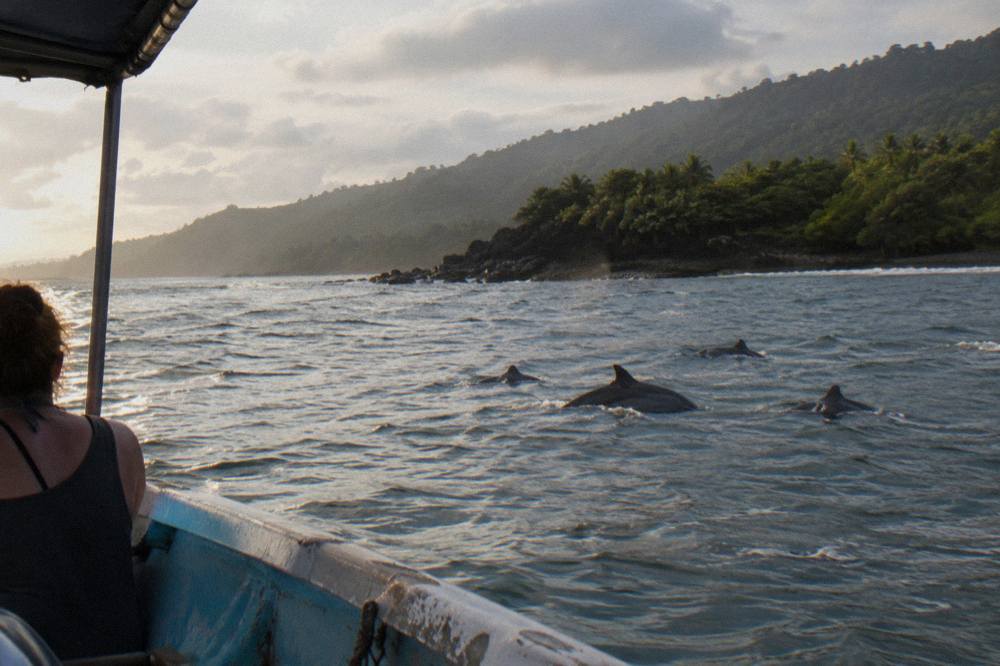
The bottlenose dolphin is the one most people picture. Spinner dolphins are also commonly reported on southern Pacific trips. Beyond the headliners, sea turtles and manta rays share the same water, but the dolphin list is essentially those three.
The word "resident" deserves a hedge. No published count of dolphin groups in Bahía Ballena exists in official or scientific sources, so any sighting rate you read on a booking page is that operator's own claim, not a measured figure for the coast. What is well established, in the IWC's handbook profile, is that Costa Rica's Pacific waters host two humpback populations from opposite hemispheres and a set of dolphin species commonly viewed on the same tours, with whale watching in the south of the country developing around Dominical, Uvita, Drake Bay, Caño Island and Golfo Dulce. Dolphins are the reliable half of that pairing precisely because they do not leave. If you end up basing yourself in Dominical rather than Uvita, our answer to What Is Dominical Costa Rica Known For? explains what the town offers on the days you are not out on the water.
| Species | Presence around Bahía Ballena | Named by |
|---|---|---|
| Common bottlenose dolphin | Year-round, commonly reported | IWC and SINAC |
| Pan-tropical spotted dolphin | Year-round, commonly reported | IWC and SINAC |
| Spinner dolphin | Commonly reported | Local wildlife accounts |
| Humpback whale | Two migrating seasons, see below | IWC and SINAC |
When Is Dolphin Watching Best Around Bahía Ballena?
Dolphins are the year-round half of the Uvita boat calendar: no month is dolphin-free, so the question is really what else shares the water with them. Southern-hemisphere humpbacks are present July to mid-November, northern-hemisphere humpbacks December to March or April, and the dry season runs from mid-December to mid-April, per the national park system.
The distinction matters for expectations. In August or September, a boat has both dolphins and a strong chance of mother-calf humpback pairs, which operator pages describe as the peak of the southern season. In June, a trough month for whales, the dolphins carry the trip almost alone. SINAC, the national conservation system that runs the park, describes a dry season from mid-December to mid-April with sporadic rain and a rainy season from mid-April to mid-December; long-term rainfall records put February and March as the driest months around Uvita.
One operator, on the listing for the 3.5-hour drinks-and-snacks boat, states its own sighting odds as 50 percent in the December to March season and 90 percent from July to October. That is a single operator's claim about its own trips, whale-focused rather than dolphin-only, not a measured rate for the coast. For the month-by-month picture on the whale side, our guide to Best Time For Whale Watching In Uvita By Month breaks the calendar down in more detail than this page needs to repeat.
If you want the strongest single window for both animals at once, the weeks around the yearly whale festival make a good anchor. Each early September the community of Bahía Ballena holds the Festival de Ballenas y Delfines, and the IWC handbook notes that during the festival tour prices drop and extra boats join the watching fleet. The 2026 edition ran over three days in early September with concerts, an artisan fair and discounted trips for nationals. Expect more boats on the water than usual.
Which Tours From Uvita Include Dolphin Watching?
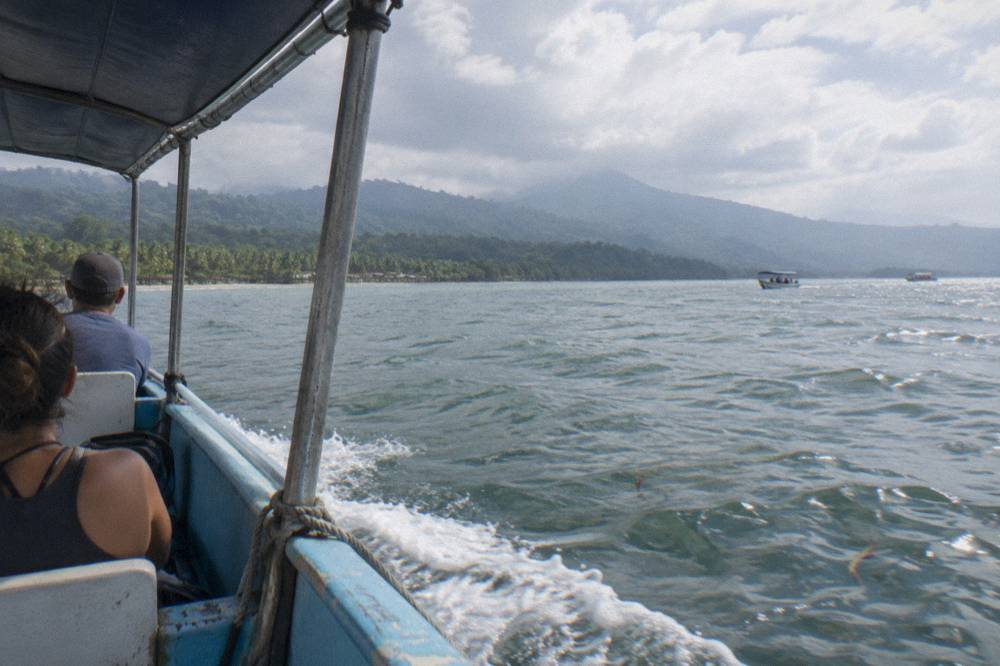
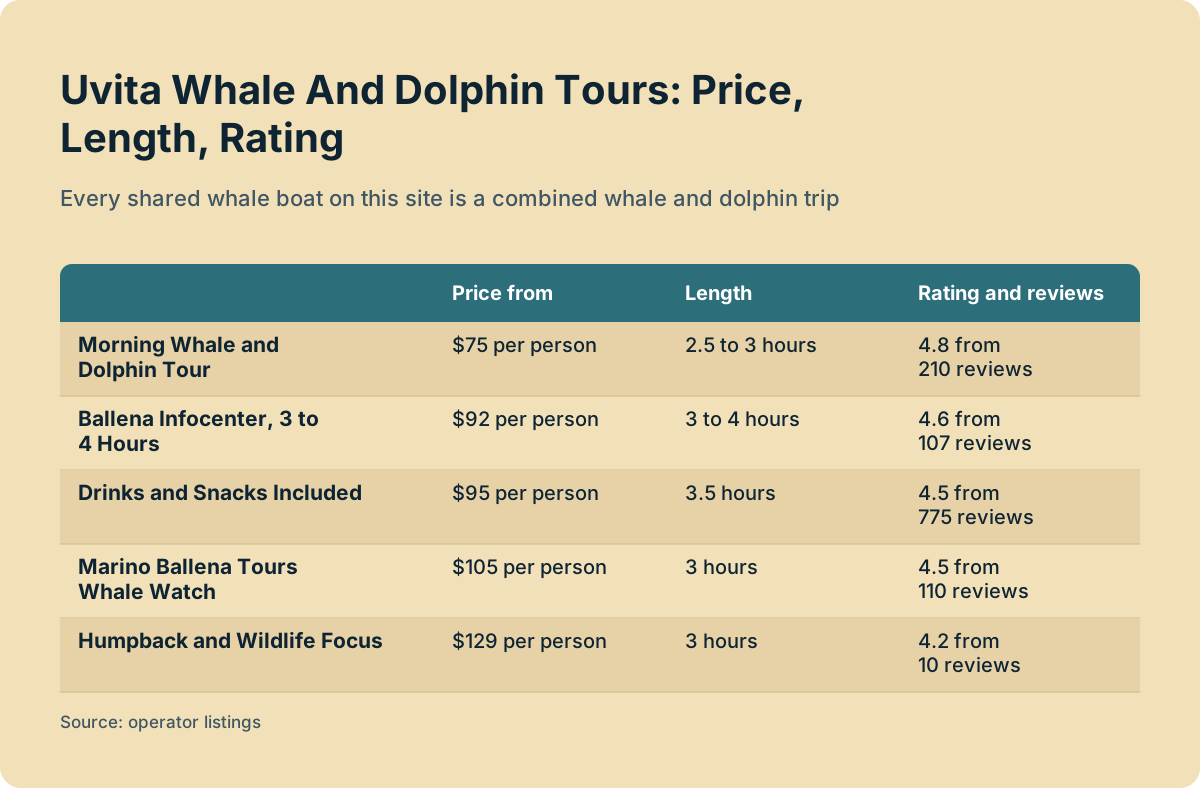
Dolphins come with the shared whale boats listed here, priced from $75 to $129 per person for roughly 3 hours, and there is no dolphin-only listing among them. The differences between listings come down to group size, inclusions like park entry and food, and departure style, not whether dolphins are on the itinerary.
The best fit depends on what kind of morning you want. The morning whale and dolphin tour from Bahía Ballena (from $75 per person, rated 4.8 from 210 reviews) is the lowest price and the shortest at 2.5 to 3 hours, with snorkel equipment listed among its inclusions, though its listing states there is no restroom on board. A guest review from that trip, Julie_B, describes how the boat handled the choice moment: "We were given the choice of finding more whales or snorkeling at the Whale’s Tail. The boat voted for snorkeling. Raymond was a fun guide."
At the other end of the scale, the humpback and wildlife-focused trip (from $129 per person, 4.2 from 10 reviews) runs with a biologist expedition leader and folds a donation to a humpback research project into the price, plus snorkeling when weather allows. Between those poles sit the workhorse listings: the drinks-and-snacks boat from $95 (4.5 from 775 reviews, up to 80 guests), a 20-guest trip with park entry and insurance from $105 (4.5 from 110 reviews), and a 3 to 4 hour tour from $92 (4.6 from 107 reviews) that adds a coffee station before departure and a visit to Whale's Rock or Ventanas Cave. One more entry-level option, a 3-hour whale watch from $80 (4.8 from 183 reviews), lists tropical fruit and park entry but no snorkeling and no restroom on board.
| Tour | Price from | Rating and reviews | Length | Dolphin relevance |
|---|---|---|---|---|
| Morning Whale and Dolphin Tour | $75 per person | ★ 4.8 · 210 reviews | 2.5 to 3 hours | Cheapest entry, dolphins and snorkel option |
| Drinks and Snacks Included | $95 per person | ★ 4.5 · 775 reviews | 3.5 hours | Most reviewed trip, up to 80 guests |
| Ballena Infocenter, 3 to 4 Hours | $92 per person | ★ 4.6 · 107 reviews | 3 to 4 hours | Coffee station, cave or rock visit, up to 20 guests |
| Marino Ballena Tours Whale Watch | $105 per person | ★ 4.5 · 110 reviews | 3 hours | Up to 20 guests, park entry included |
| Humpback and Wildlife Focus | $129 per person | ★ 4.2 · 10 reviews | 3 hours | Biologist leader, research donation, wildlife emphasis |
Group size is the quiet variable. The listings that state a cap say up to 80 guests on the big boat and up to 20 on the smaller ones; most listings simply do not state one, so check the listing if a crowd matters to you. A review from the 3 to 4 hour trip, Rosemarie, captures what a 20-guest dolphin-and-whale morning can look like: "Keller was a superb guide and captain Jordan and his crew were great! We observed a mother and baby humpback whale for at least 20 minutes. In addition we saw some sea turtles and had the chance to swim in the sea."
How Close Do Boats Get To Dolphins In Costa Rica?
Costa Rican rules set a 50-metre minimum distance from dolphins with the engine on, 30 metres with the engine off, and a maximum of 30 minutes with any group of cetaceans, under Decreto Ejecutivo 32495, the 2005 regulation governing cetacean activities. At most two boats may circle the same group at once, boats travel no faster than 4 knots in observation areas, and swimming with dolphins is prohibited.
The regulation also forbids splitting or dispersing a group, coming between a mother and calf, feeding the animals, and excessive noise. The full text is on the official legal database, and the practical summary is simple: the boat approaches slowly from behind and at an angle, matches the group's speed, and moves off when the animals show disturbance.
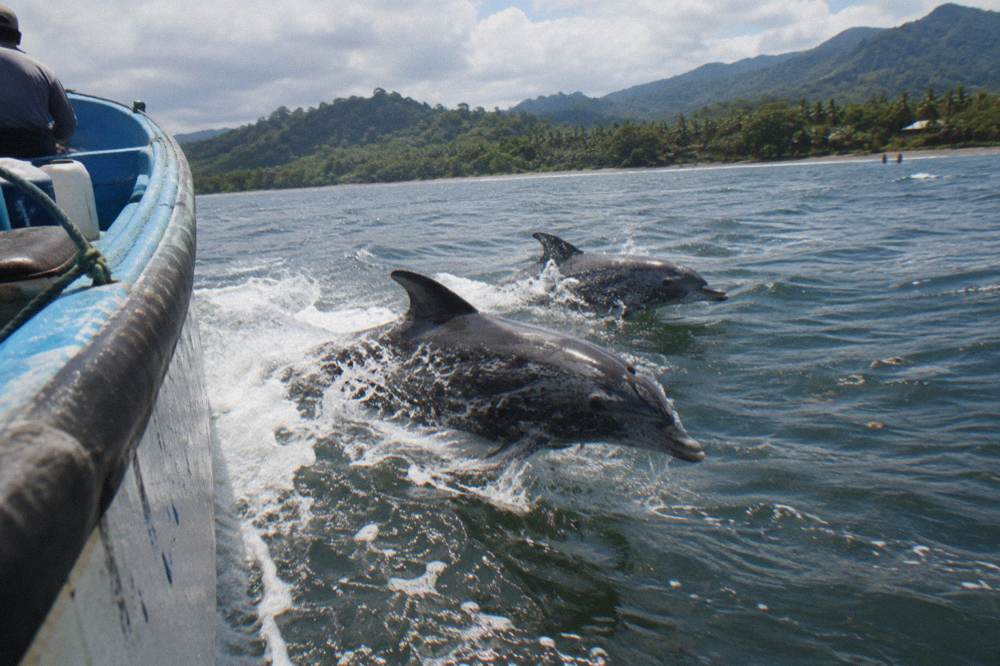
Our guide to Whale Watching Boat Rules And Ethics In Costa Rica walks through the whole framework; for dolphin purposes the three numbers that matter are 50 metres, 30 minutes and two boats.
| Rule under Decreto 32495 | What it means on the water |
|---|---|
| 50 m from dolphins, engine on | The boat keeps its distance while moving near a pod |
| 30 m from dolphins, engine off | Drifting or stationary viewing happens closer, never closer than this |
| 30 minutes maximum per group | Every boat rotates away after half an hour, dolphins or whales |
| Two boats maximum per group | A third boat waits 200 m back |
| 4 knots in observation areas | Slow approach, slower than the slowest animal |
| No swimming with cetaceans | You watch from the deck, never in the water beside them |
Will You Actually See Dolphins From A Uvita Boat?
Dolphins are the more dependable sighting on any Uvita trip, because resident pods mean a chance in every month, but no operator can promise a pod on a given morning, and none of the listings here guarantees one. Boats also cancel or reroute for sea state, and several listings state plainly that the trip depends on conditions, so the honest framing is a strong likelihood, never a certainty.
Guest reviews give a fair picture of the hit rate. On the 3-hour Marino Ballena Tours trip, Tessa writes: "We were lucky enough to see a mother whale and her calf, and at another spot, we also saw a bull with some dolphins." On the whale and snorkel combo, Mira_S describes how the fleet cooperates: "they had excellent communication with other boats so once one whale was spotted we were able to get there quickly and be very close to them."
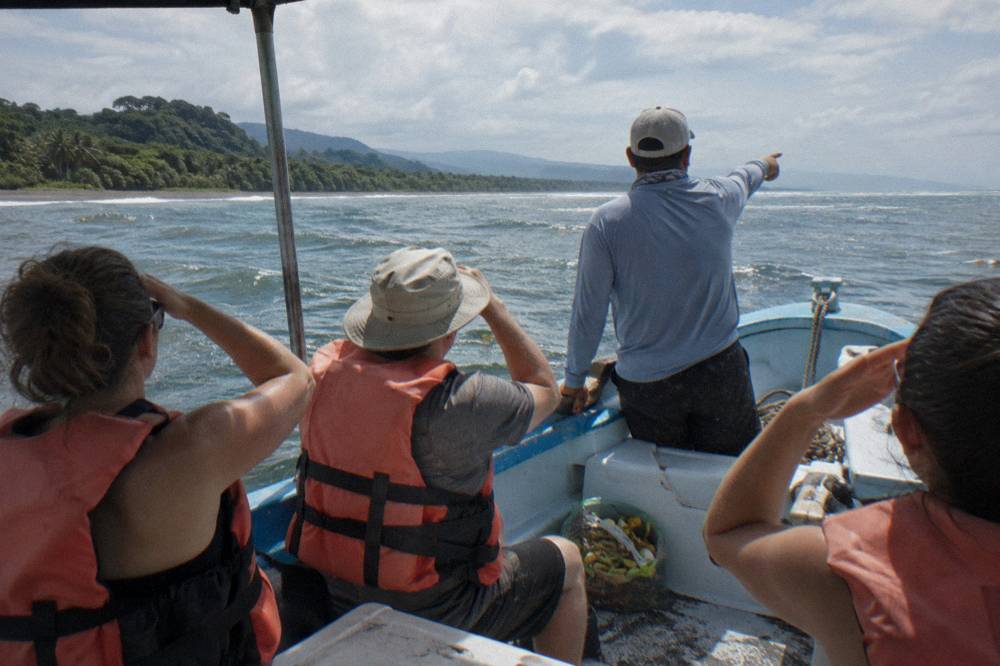
If you are weighing the odds month by month, our guide to Will You See Whales: Sighting Odds And Best Departure Time pulls the operator-stated figures together in one place, with the same attribution caveats that apply here.
Is Dolphin Watching In Costa Rica Suitable For Families?
Yes, with two practical notes: no listing publishes a minimum age, and boarding is often from the beach, with no dock, meaning guests wade briefly to the boat. Beyond that, a 2.5 to 3 hour shared trip is short, and many listings include safety gear, fruit, water and, on several trips, a swim stop.
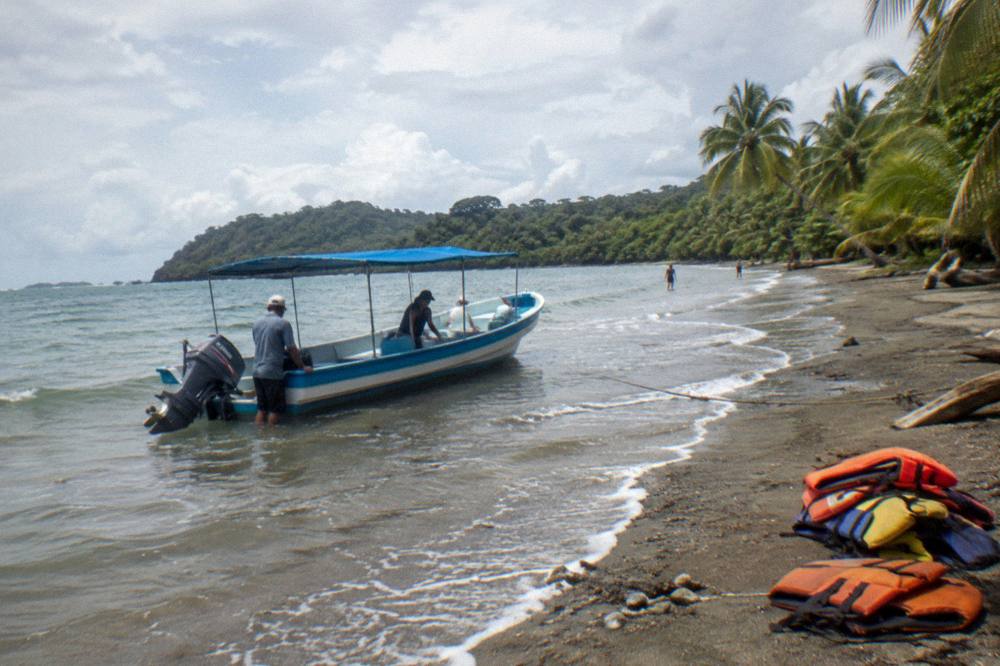
The beach launch surprises people. At least one Uvita listing states it outright in its exclusions: there is no dock, and boarding happens directly from the beach. Wear shorts you do not mind wetting, keep shoes that grip sand, and expect to step into the water. The whale and snorkel combo from $84.42 (4.3 from 136 reviews) and the midday version of the same trip (4.3 from 35 reviews) both list snorkel equipment and safety gear among the inclusions. The morning tour is the shortest, though it has no restroom on board. Our guide to Whale Watching With Kids In Uvita: Ages, Safety And Timing goes deeper on ages, motion sickness and what to pack.
Free cancellation is listed on nearly every trip in this family, which matters when you are betting a vacation morning on children's moods and the ocean's. The details, cutoffs and refund terms live on each operator's live listing rather than in any summary, so read them before booking rather than after. Uvita Whale Watching compares every listing side by side.
How Does Uvita Compare For Dolphin Watching In Costa Rica?
Uvita sits inside Marino Ballena National Park, a marine park created specifically for its ocean life, and its dolphin watching overlaps with Drake Bay, Caño Island and Golfo Dulce, the other historic centers of Costa Rican whale watching per the IWC. If you're wondering whether you can actually get in the water here, our answer to Is It Safe To Swim In Uvita? covers tides, reef snorkeling, and the rules around swimming near whales and dolphins.
The comparison that matters most here is against the full-day Caño Island snorkel trips, which are a different product entirely: 6 to 8 hours, from $150 per person, focused on reef snorkeling rather than cetaceans, and never promised as a whale trip. If dolphins are the goal, the half-day bay trips are the right instrument. If you want both, pair a morning dolphin-and-whale boat with the whale and snorkel combo logic or a separate Caño day. The deeper head-to-head on the two day trips is laid out in our guide to Caño Island Vs Marino Ballena: Which Boat Day To Pick.
Reaching Uvita is its own small decision. San Jose to Uvita by road via Route 34 runs about 222 km and roughly 3 hours 28 minutes by one route estimate, with other estimates stretching to just over 4 hours; Dominical to Uvita is about 18 km and 15 minutes on the same highway. Tracopa runs buses from San Jose on the Costanera route, but treat the fare as "check Tracopa" rather than a printed number. The park itself charges non-resident adults USD 6.78 and children USD 5.65, card payment only, though on most of these tours the park entry is already folded into the trip price, as each listing's inclusions show.
Whichever listing you choose, book the morning with the sea in mind rather than the calendar alone: dolphins will be somewhere in that bay, the rules keep the encounter respectful, and a boat that lists free cancellation gives you an out if the Pacific decides otherwise.
Common Questions About Dolphin Watching From Uvita
Which Dolphins Are Seen In Bahía Ballena?
Common bottlenose dolphins, pan-tropical spotted dolphins and spinner dolphins are the three species commonly reported around Bahía Ballena and Marino Ballena National Park, with bottlenose and spotted dolphins named in the IWC's Costa Rica profile as species commonly viewed on tours.
Is There A Dolphin-Only Tour From Uvita?
No. The whale boats listed here double as dolphin trips. Dolphins are resident year-round, so they can turn up on any departure, but the listings are built around both animals plus, on several trips, a swim or snorkel stop.
What Is The Best Time Of Year For Dolphin Watching Around Uvita?
Dolphins are present in every month, so any time works for them. If you want dolphins and the strongest whale odds together, aim for August to September, when southern-hemisphere mother-calf pairs peak; for calmest seas, target the dry season from mid-December to mid-April.
How Close Can Boats Get To Dolphins In Costa Rica?
Under Decreto Ejecutivo 32495, boats stay at least 50 metres from dolphins with the engine on and 30 metres with it off, spend no more than 30 minutes with a group, and allow no more than two boats around the same animals. Swimming with dolphins is prohibited.
How Much Does A Dolphin Watching Trip From Uvita Cost?
Shared whale and dolphin trips run from $75 to $129 per person for roughly 3 hours, with the lowest-priced listing, the morning tour from Bahía Ballena, at $75 per person. Park entry is included on most listings, as each listing's inclusions state.
Can You Swim With Dolphins In Uvita?
No. Costa Rican regulation prohibits swimming, diving and any in-water activity around cetaceans, and no licensed Uvita operator offers it. Swim stops happen at reef or beach locations away from the animals, and only when conditions allow.